
.svg)
Roombook: Structured, digital building data
As part of our CAD modeling services, Lumoview provides digital room books for professionals who require structured, room-based as-built data for planning, analysis, property management, or energy assessments. By combining high-precision geometric 3D data with detailed room-related information, we create the perfect complement to the 3D model. Our digital room book contains a structured overview of all rooms and floors within your property, including all relevant attributes. This enables efficient building management, maintenance, and analysis.
Lumoview delivers a reliable, error-free data foundation for energy consulting, renovation planning, and facility management. The data is standards-compliant, ready to use, and tailored to your specific application. Depending on your needs, the room book is available in different formats:
✓ Overview list
✓ Detailed list
✓ Custom list
The Lumoview roombooks in 3 levels
We tailor your roombook precisely to your needs. Depending on the purpose, you can choose between a general, detailed or individual list and get exactly what you need.

General list for a quick check
✓ The roombook as a general list contains an overview of rooms by property and floor with all basic information.
✓ The area is calculated either according to DIN 277 or the Living Space Ordinance (Wohnflächenverordnung, WoFlV).
✓ The room list is suitable for a quick and intuitive overview.
Detailed list for professional planners
✓ The detailed list combines the area calculation according to DIN 277 and the Living Space Ordinance (Wohnflächenverordnung, WoFlV).
✓ It is particularly suitable for administration and for quick cost estimates for renovations and refurbishment costs.
Individual list for the highest demands
✓ The individual list is based on specialised area calculations, e.g. according to Austrian standards (ÖNORM) or the guidelines of the Swiss Society of Engineers and Architects (SIA).
✓ It is tailored to your specific needs and includes detailed structural features and building technology components (e.g. TGA, radiators, materials).
✓ This list is suitable for the highest requirements and complex planning tasks.
Benefits of roombooks
Roombooks offer significant added value as a supplement to 3D models. They present all relevant room and surface data in a clear and standardised format so that you can reuse it directly.
Structured room data
The roombook provides you with all the important key figures in a clear table format. This makes evaluations, comparisons and analyses easier than when viewing a 3D model purely visually.
Transparency & comparability
Standardised room lists ensure clear, uniform documentation. Especially for large property portfolios, they facilitate management, create transparency and increase efficiency in the long term.
Efficient workflows
With the direct export of structured data lists, error-prone manual data transfers from the 3D model are no longer necessary. You receive ready-to-use data for downstream processes, minimize correction efforts, and accelerate the entire project workflow.
Roombook template vs. Lumoview roombook
The classic Excel template is prone to errors. Anyone looking for a roombook template wants to bring structure to their construction project. An Excel roombook template provides a basic framework for this, but quickly reaches its limits:
- Manual data entry on site with a folding rule and clipboard is time-consuming and prone to errors.
- Transcription errors and inconsistent area calculations often lead to costly planning mistakes in renovation or facility management.
The Lumoview benefit: automated data collection
Lumoview replaces manual list filling with a digital workflow. With the LumoScanner, you can capture every room in just 2 seconds. Our cloud AI automatically links the geometric 3D data and provides the room-related attributes in a structured manner. The result is a digital room book that enables interactive evaluation of your area data, quality-assured, consistent and immediately available as XLSX, CSV or PDF. You save a lot of time and receive a reliable database in accordance with DIN 277 and WoFlV.
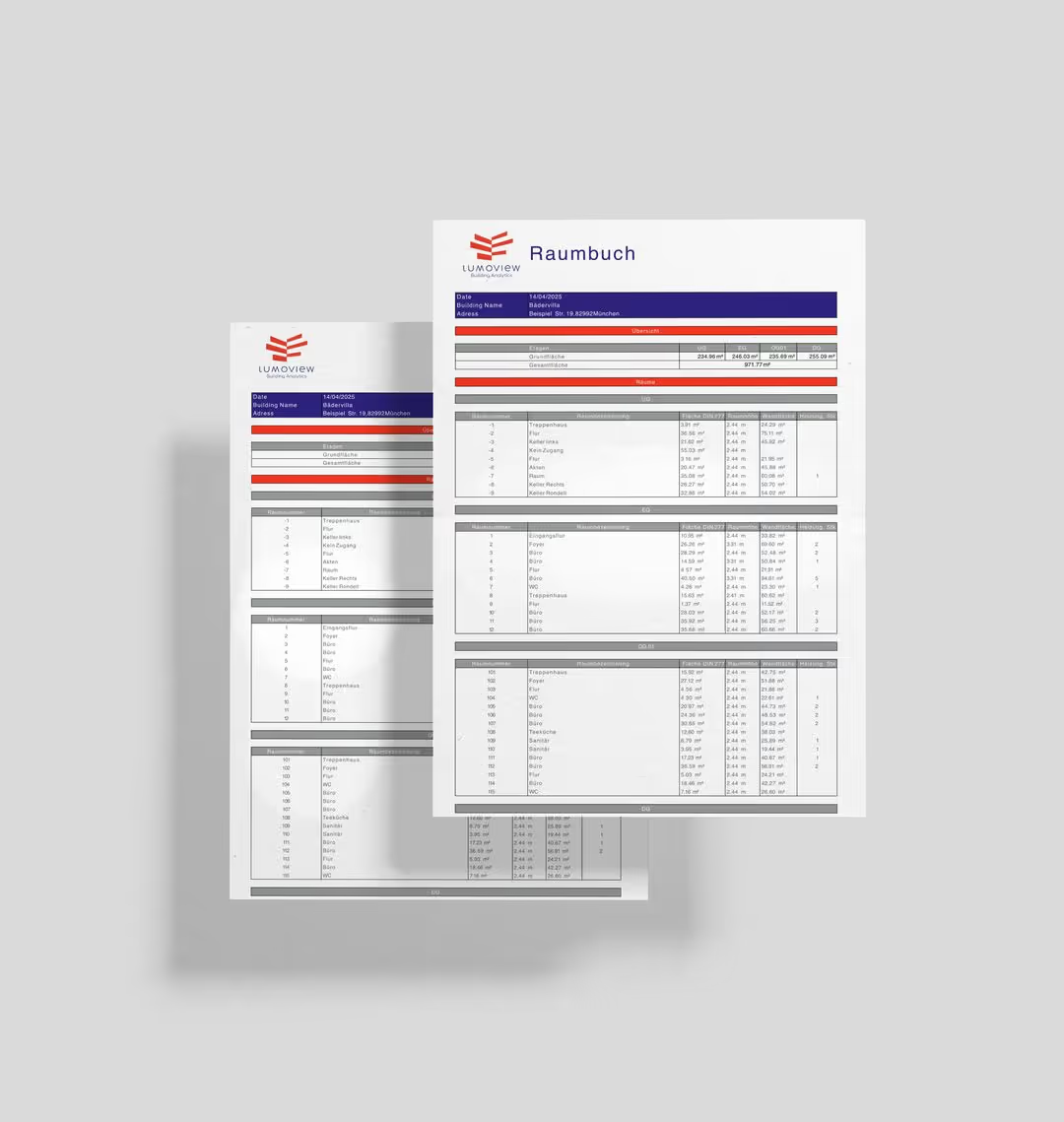
The Lumoview roombook: this is what it looks like
.avif)
Our Lumoview roombook provides you with a valid data basis for planning, tendering and management. We convert the physical inventory into structured lists that link geometric and alphanumeric information.
✓ Structured room attributes: from floor coverings to building services
Our data structure accurately reflects reality. We record specific attributes for each room: from the exact room designation and usage codes (DIN 277 / GIF) to equipment features such as floor coverings, suspended ceilings or building services components (e.g. radiators, air conditioning). This granularity enables you to directly determine quantities and estimate costs without having to take new measurements on site.
✓ Visual documentation: location in the floor plan and photo documentation
Tabular data derives its full value from the spatial context. In our reports, room lists are directly linked to 2D floor plans and high-resolution 360° photos. This allows you to visually check the condition of windows, doors and surfaces and validate defects or renovation requirements from your desk.
Use cases: What are roombooks used for?
Lumoview's digital roombook serves as a complete documentation of your inventory. It provides architects, energy consultants and administrators with a reliable basis for:
Renovation cost estimates
Precise measurements (e.g. floor coverings, wall surfaces) instead of rough estimates.
Facility Management
Efficient management thanks to up-to-date data on room furnishings and building services components.
Energy consulting
Sound data basis for complex calculations such as thermal building simulation.
Digital inventory management
Transparency throughout the entire building life cycle.
What is a roombook?
A roombook is a central document for construction planning and renovation that brings together all relevant information on the individual rooms of a construction project in a structured manner. It is the "DNA" of your building in tabular form. It links room stamps, geometry and attributes. It serves as a reliable basis for planning, execution and subsequent management.
Depending on the project phase, a distinction is often made between a
- planning-accompanying roombook (requirements/usage objectives),
- a roombook accompanying construction (execution, quantities/costs, TGA details) and
- Usage or inventory roombook (operation, maintenance, facility management).
Contrary to what the term might suggest, today's roombook is no longer a "book" but a digital, machine-readable data structure (e.g. Excel/CSV or database).
What does a roombook contain?
A roombook usually contains the following:
- Address of the building and the floors,
- Room numbers and room names,
- Floor areas and dimensions of the rooms (e.g. length, width, height, area, volume),
- Materials (e.g. wall and floor coverings, ceilings, built-in furniture) and
- equipment (e.g. heating, air conditioning, ventilation, sanitary or electrical installations).
In addition, information about the planned use and associated specific requirements for the room can also be included.
FAQ – Frequently asked questions about the Lumoview room book
We provide you with the finished roombook as an Excel file (.xlsx), CSV or PDF as standard. These formats allow you to process the data directly in your usual software environment or import it into CAFM systems.
Our calculations are carried out as standard in accordance with DIN 277 (floor areas and room volumes) or the Living Space Ordinance (WoFlV). If required (Level 3 / Tailor-made), we also evaluate according to GIF, ÖNORM or SIA.
Yes. Since we provide structured data (e.g. as CSV or XLSX), it can be easily imported into common CAFM or ERP systems. The clear column structure (room ID, use, area, etc.) makes it easy to assign data to your database fields.
That depends on your goal:
- Level 1 (overview): Ideal for a quick overview of your portfolio and leasing (basic data according to DIN 277/WoFlV).
- Level 2 (detailed): Perfect for administration and cost estimates for renovations (detailed area breakdown).
- Level 3 (customized): For the highest demands, e.g. with TGA recording, materialities or special standards (ÖNORM/SIA).
The roombook reflects the exact condition at the time of scanning. Since the LumoScanner digitises the inventory in a matter of seconds, you get an "as-built" image of reality – no outdated plans.
.avif)
All building data at a glance!
We create or update your as-built building data accurately and efficiently.