
.svg)
Digital twin: All-in-one solution for building data
With Lumoview, you benefit from a holistic and efficient all-in-one approach to digital building capture. Our end-to-end full-service solution provides digitally structured building data throughout the entire lifecycle of a property.
Our technology captures as-built data within seconds, processes it automatically, and delivers it as a digital twin: efficient, seamlessly integrable, and sustainable. Whether for as-built documentation, reality capture, or building analysis, Lumoview combines efficiency and seamless system integration in a single solution.
What is a digital twin?
A digital twin is a virtual, dynamic representation of a planned or actual physical object, process or system. It is the central database used to simulate, observe, analyse and optimise its real-world counterpart throughout its entire life cycle.
While the term often refers to dynamic real-time data in industry, in construction (AEC) and facility management, the digital twin is the digital representation of the actual building stock. It forms the bridge between the physical property and digital processes such as renovation planning, energy management or building stock management. Without precise geometric and thermal recording of the current status – as provided by Lumoview – the foundations for the digital transformation of your portfolio, from renovation to IoT networking, are missing.

Building data in just 3 steps
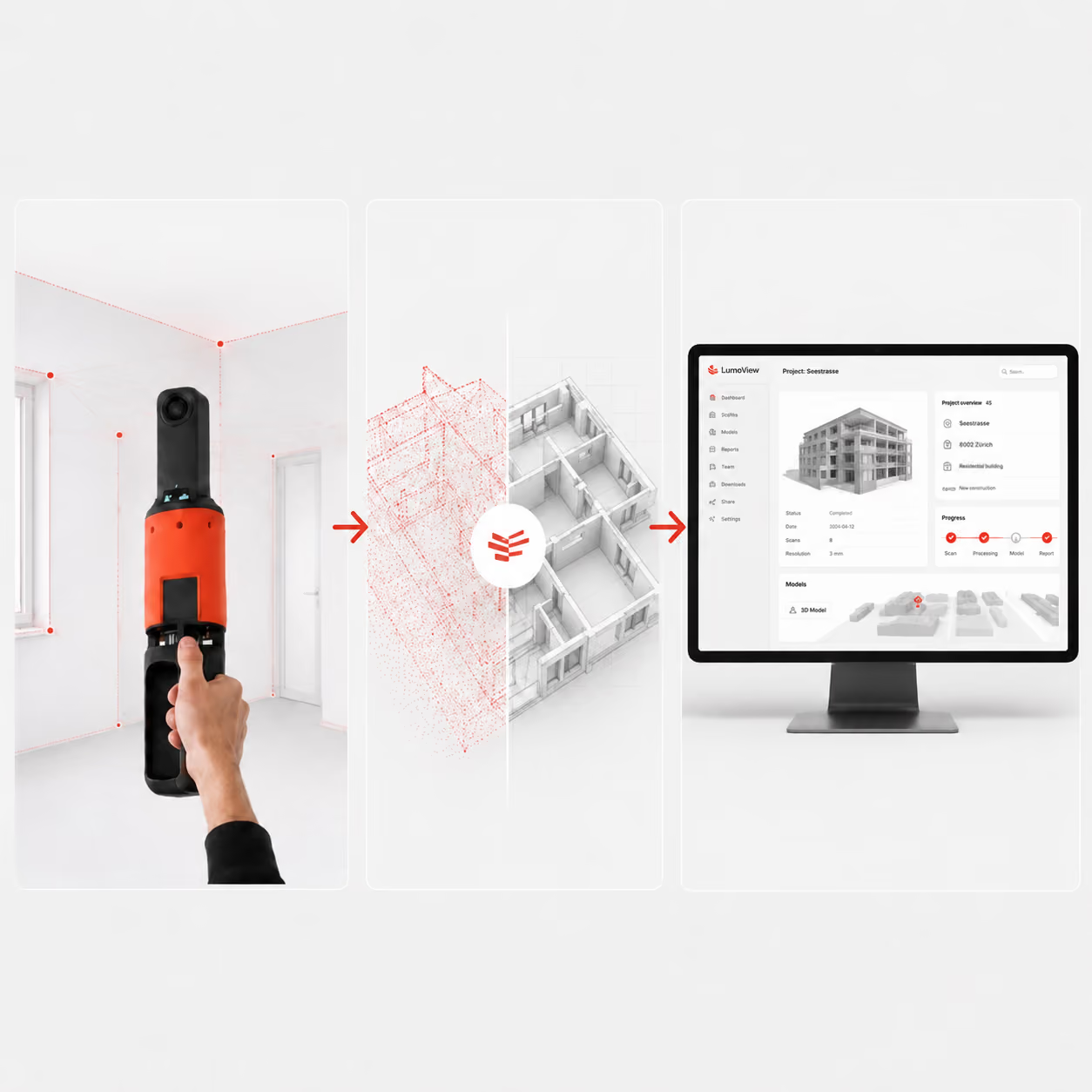
With Lumoview, data is captured in seconds, automatically processed and made available digitally. Measure once – use multiple times: thanks to our full-service offering, you not only receive precise measurement results, but also seamlessly integrable digital models in just 3 steps:

LumoScanner
Caupture
building data
You can take digital measurements in just 2 seconds per room with Lumoview's patented technology. We combine 360° photography with high-precision LiDAR sensor technology.

LumoCAD Engine
Process
building data
We process the building data in an automated process to create 3D CAD models, floor plans, room books, views & sections, photo documentation, and much more. AI-supported object recognition analyses the raw point cloud, identifies components such as walls, windows or doors, and classifies them automatically.
LumoCloud
Use
building data
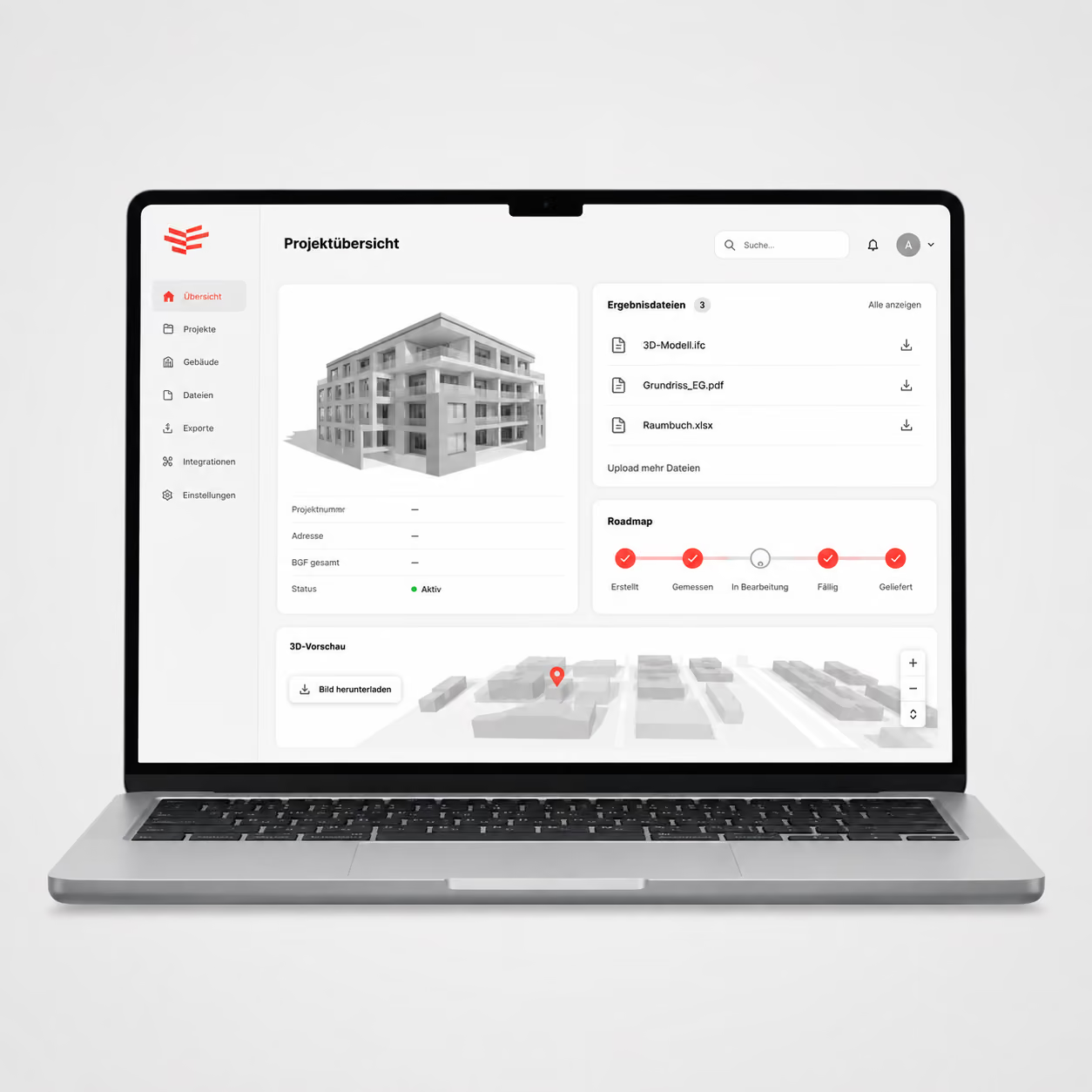
You get centralised access in our cloud-based plattform to all data in industry-standard formats such as IFC, RVT, HottCAD, DWG and PDF. The end product is processed building data in the form of digital twins.
EPBD: Digital inventory documentation
EU Directive 2024/1275 on the energy performance of buildings (EPBD) focuses on improving the energy efficiency of existing buildings – it will be gradually transposed into national law by 2026. For architects, engineers, facility managers and construction professionals, reliable inventory data is therefore a prerequisite for planning measures accurately, evaluating variants and creating comprehensible documentation. Lumoview provides you with the digital data basis for this.
Your benefits at a glance
With its 3-step process of data collection (digital measurement), data processing (CAD modelling) and data management (LumoWorld building data platform), Lumoview offers a prime example of efficiency, flexibility and ease of use. Architects and engineers, as well as construction and real estate professionals, benefit from our all-in-one solution on several levels:
Simple & intuitive
Intuitive technology – from the scanner to the LumoWorld platform. No prior knowledge required, ready to use immediately and quickly integrated into existing workflows. This allows everyone involved to work efficiently with the building data without complex training.
Precise, reliable, plannable
Accurate data instead of assumptions: Lumoview provides a reliable foundation for planning, analysis, and documentation, which is essential for AEC projects. Standardized digital workflows make surveying and modeling predictable and scalable, creating a consistent data basis for precise project planning in terms of personnel, materials, and costs.
Efficient and to the point
You receive exactly the data formats, levels of detail and information that your project requires – no more and no less. By working only with relevant and usable building data, unnecessary data overload is avoided, reducing effort in planning, coordination, and downstream processing.
Up to 35% faster
Modern technology speeds up the entire process, from measurement and CAD modelling to central data management. Manual steps are eliminated, processes flow seamlessly into one another and results are available more quickly. According to estimates, this can reduce the overall project effort by up to 35%.
Holistic Solution
Lumoview provides a complete digital workflow across the entire building lifecycle—from capturing the real-world condition of a building to automated modeling and the creation of a digital twin. Integrated, automated, and scalable, every step is technically and structurally aligned, ensuring a solution that grows with your requirements.
Seamlessly integrable into your systems
All captured building data can be integrated directly into existing CAD, CAFM, ERP and other target systems – without media discontinuity or manual transfers. Work with industry-standard formats such as IFC, RVT, DWG or PDF and simply continue to use the data. This allows the digital twin to integrate seamlessly into your existing processes.
Das right model for every need
Our focus is on creating precise 3D CAD models as a digital basis for the planning, operation and further development of buildings. In addition, we supply all relevant 2D plans and analysis formats, such as floor plans,
views and sections, as well as room books, area calculations and thermal analyses. This means you receive exactly the evaluations and models you need.
3D CAD drawings
Digital, detailed CAD models that simplify the documentation of a building's existing structure and enable efficient planning in the AEC sector.
Floor plans
Digital floor plans for precise, virtual representation of room layouts and as a basis for further planning and inventory documentation of buildings.
Room books
Detailed room books for quick recording and documentation of building structures, ideal for facility management and the sustainable use of real estate.
Area calculations
Precise area calculations in accordance with DIN 277 and other relevant standards for efficient inventory measurement and room planning.
Thermal analyses
Thermal analyses for assessing the current condition of buildings and planning energy-efficient renovations, supported by digital solutions and AI-assisted processes.
Frequently asked questions about digital twins
A digital twin accurately depicts the actual condition of a building in the form of precise digital models. This enables well-founded building analysis, efficient planning
in the AEC sector, sustainable facility management, predictive maintenance and preparation for energy-efficient renovations. All data is available centrally, up to date and in the desired level of detail at all times.
There are basically four types of digital twins:
1. Component twins digitally map individual components within a system or device, such as a pump, to improve overall performance.
2. Asset twins virtually replicate an asset in its entirety, such as a building or a machine. The objectives include planning maintenance work, reducing downtime, lifecycle management and value retention, optimising operations and increasing energy efficiency. Lumoview provides the basis for this by precisely capturing the real building stock and making it available as a digital building twin. This forms the entry point for further system and process twins in building operation and energy management.
3. System twins capture complex systems or plants in their entirety. They connect several asset twins, so to speak, and simulate their interaction as a whole in order to reveal dependencies. Examples of applications include production lines, energy networks and complex building services.
4. Process twins focus on replicating dynamic workflows and processes. They reveal bottlenecks and serve to minimise risk and increase productivity and quality, for example through improved throughput times or efficient use of human resources.
A digital shadow collects data, i.e. the data only flows in one direction, from reality to the digital world. It is used purely for monitoring purposes.
A digital twin exchanges data, i.e. it works bidirectionally. It communicates with the object and often actively controls the building.
BIM is a working method for model-based planning and documentation and is based on a predominantly static planning and inventory model.
A digital twin is a dynamic model enriched with real-time and operating data (IoT).
Image for analysis and operation. It is dynamic and constantly adapting.
A simulation, on the other hand, uses data from the twin to predict scenarios such as energy consumption. Lumoview provides the foundation for both: reliable digital geometry.
Digital inventory documentation is the basis for transparency, planning reliability and regulatory compliance – especially when building in existing structures or complying with legal standards (e.g. DIN 277). It minimises planning errors, reduces risks and saves time and costs in the long term through reusable data.
A digital twin is not artificial intelligence per se, but it is made possible by it. At Lumoview, we use AI to automatically interpret the huge amounts of data from the scans. The AI recognises walls, windows and doors and converts them into structured CAD elements. The twin is therefore the result, while the AI is the tool that makes the process fast and scalable.
A twin is only as good as its data. While sensors often provide real-time values, the geometry is a snapshot. However, thanks to the radically fast capture with Lumoview, the digital inventory can be kept up to date without much effort in the event of renovations or changes in use. This ensures that your model remains valid in the long term.
Yes, thanks to open standards such as IFC, DWG and RVT (Revit), the twin is compatible with all common architecture and FM programmes (CAD, BIM, CAFM).
We currently support project management in German and English – both in communication and in data preparation and documentation. Our LumoWorld platform is supported in five languages: German, English, Spanish, French and Finnish.
Lumoview is used throughout Germany and also serves project-related clients throughout Europe.
Please contact us. We are happy to take on international projects!
.avif)
Free consultation