
.svg)
A BIM Execution Plan (BEP), describes how the BIM requirements of a construction project will be implemented in practice. It defines processes, roles, responsibilities, data exchange and quality requirements, creating a shared basis for collaboration between everyone involved.
The BEP translates the Exchange Information Requirements into a practical project framework. It specifies how the defined BIM objectives, use cases and information requirements will be fulfilled.
Why is a BIM Execution Plan important?
- Clear collaboration: Roles, responsibilities and coordination processes are clearly defined.
- Consistent data structures: Specifications for models, attributes, naming conventions and exchange formats reduce inconsistencies.
- Reliable information exchange: The BEP defines which information must be provided, when and by whom.
- Quality assurance: Model reviews, approvals and validation processes are agreed before the information is delivered.
- Transparent BIM processes: Changes, responsibilities and information flows remain traceable throughout the project.
What does a BEP contain?
The precise structure depends on the project, the client and the BIM use cases. Typical components include:
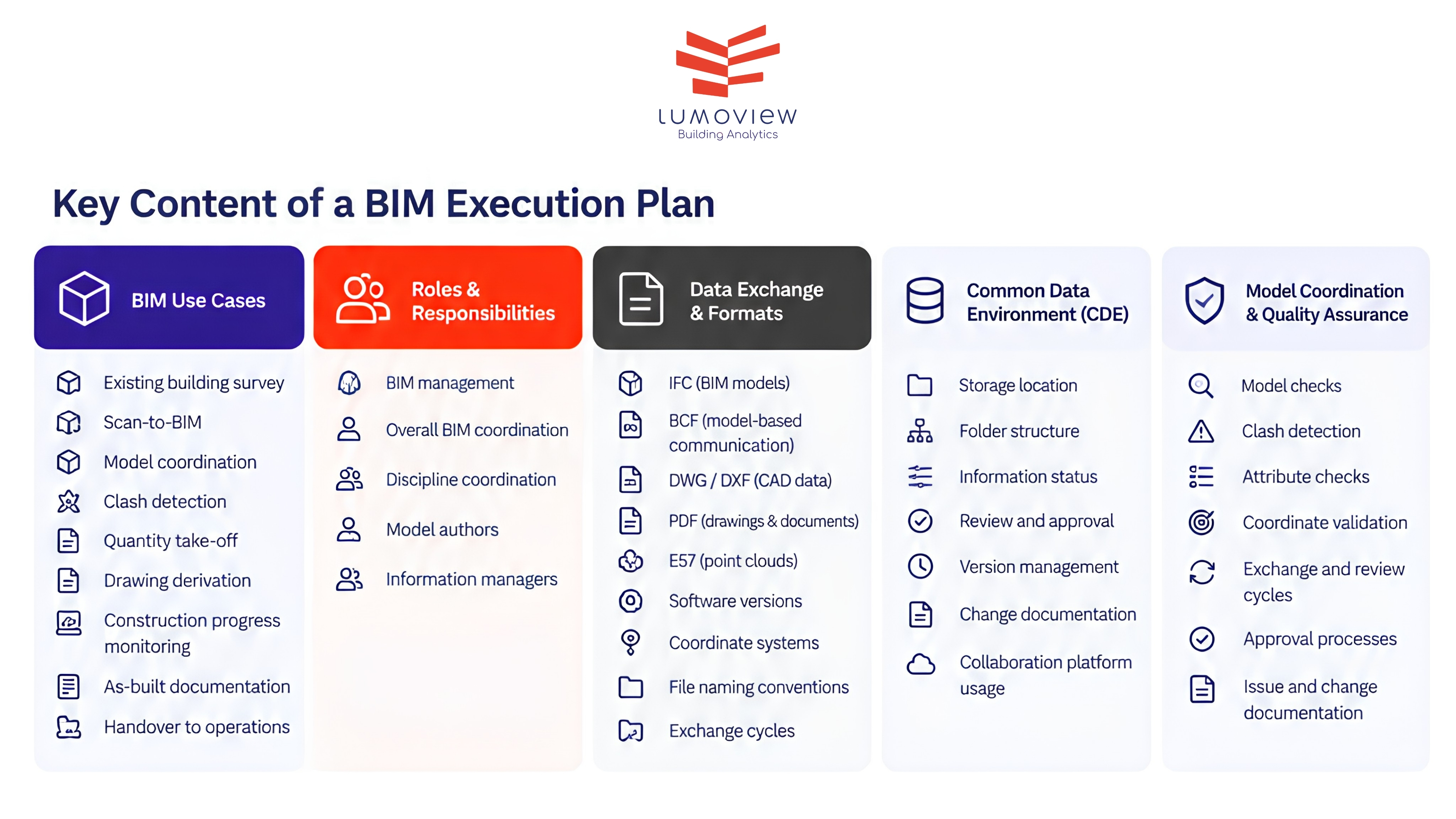
BIM use cases
The BEP describes how the agreed BIM use cases will be implemented.
These may include:
- Existing building surveys
- Scan-to-BIM
- Model coordination
- Clash detection
- Quantity take-offs
- Drawing generation
- Construction progress monitoring
- As-built documentation
- Handover of building data for operation
Roles and responsibilities
The BEP specifies which project participants are responsible for each BIM task.
Typical roles include:
- BIM management
- Lead BIM coordination
- Discipline-specific BIM coordination
- Model authors
- Information managers
The key requirement is to assign clear responsibilities for model creation, review, coordination and approval.
Data exchange and formats
The BEP defines how information will be exchanged between project participants.
Typical formats include:
- IFC for BIM models
- BCF for model-based communication
- DWG or DXF for CAD data
- PDF for drawings and documentation
- E57 or other formats for point clouds
Software versions, coordinate systems, file-naming conventions and exchange cycles may also be specified.
Common Data Environment (CDE)
The BEP often also describes how the Common Data Environment will be used.
For example, it may define:
- where information is stored
- which folder and data structure applies
- which statuses information passes through
- who is authorised to review and approve data
- how versions and changes are documented
This creates a consistent information base for all project participants.
Model-based coordination is often carried out through a BIM collaboration platform. The BEP defines how this platform is used, including coordination cycles, review rules and responsibilities.
Model coordination and quality assurance
Rules for model review and coordination are another key component.
These may include:
- Model reviews
- Clash detection
- Attribute checks
- Coordinate checks
- Exchange and review cycles
- Approval processes
- Documentation of changes and issues
How is a BIM Execution Plan developed?
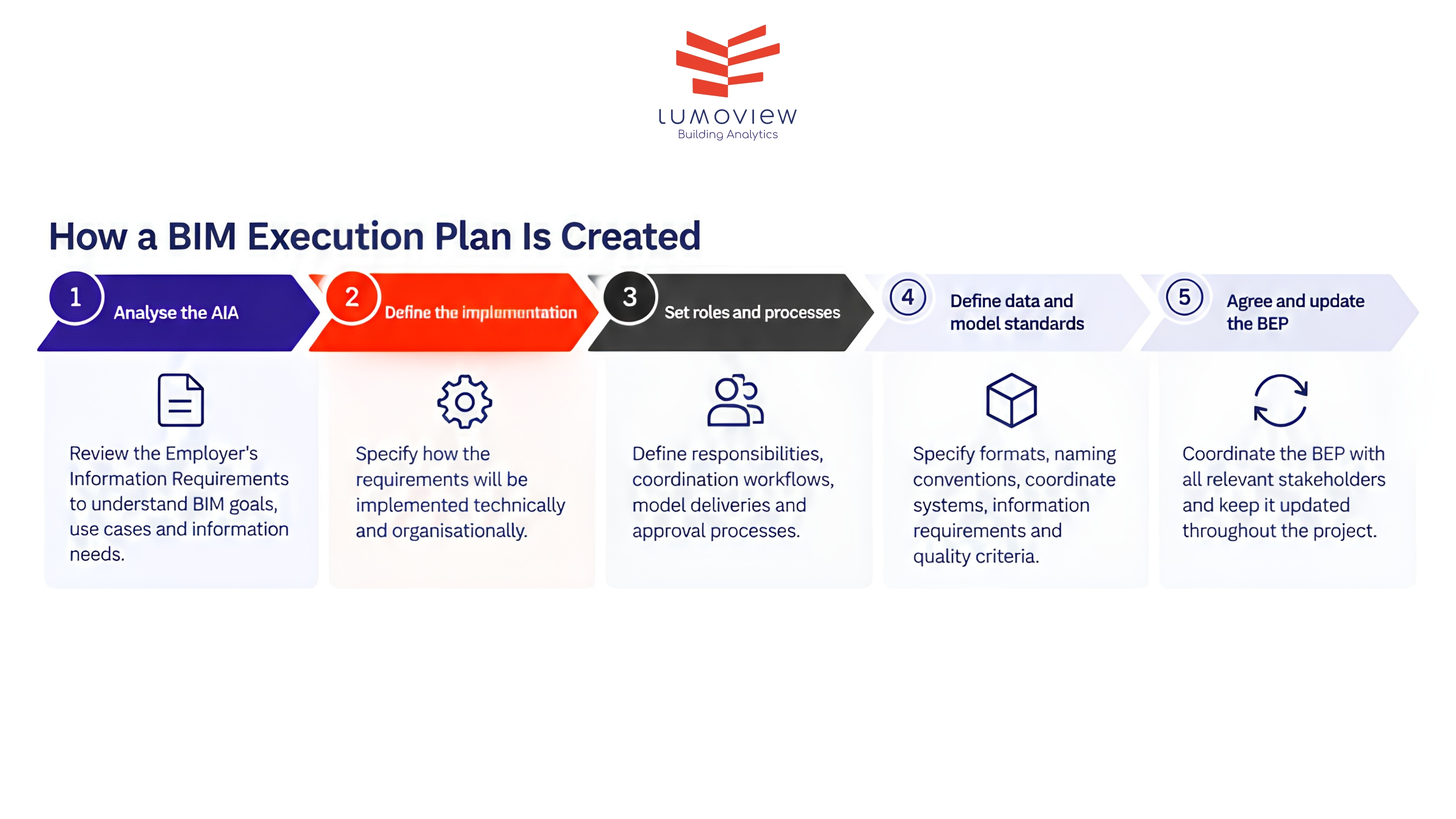
1. Evaluate the EIR
The starting point is the Exchange Information Requirements. They define which information is required for the BIM objectives and use cases.
2. Specify the implementation
The project participants determine how these requirements will be met from a technical and organisational perspective.
3. Define roles and processes
Responsibilities, coordination procedures, model deliveries and approval processes are agreed.
4. Establish data and model standards
Formats, naming conventions, coordinate systems, information requirements and quality criteria are documented.
5. Agree and update the BEP
The BIM Execution Plan is agreed with the relevant project participants. Because processes, participants or requirements may change during the project and across its different phases, the BEP is continuously updated.
BEP vs. EIR
AIA and BEP are closely connected, but they serve different purposes.
Exchange Information Requirements (AIA)
- are defined from the client’s perspective
- describe which information is required
- define BIM objectives and information requirements
- provide a basis for tendering and appointment
BIM Execution Plan (BEP)
- specifies how the requirements will be implemented
- describes processes and responsibilities
- defines data exchange, coordination and quality assurance
- is updated during the project when necessary
Put simply:
- AIA = What is required? Comparable to a requirements specification.
- BEP = How will it be implemented? Comparable to an implementation specification.
Common mistakes and misconceptions
- “A BEP is only a template”: A standard template can be helpful, but it must be adapted to the BIM objectives, use cases and project organisation.
- Mixing up AIA and BEP: The client’s requirements and their practical implementation should remain clearly separated.
- Creating the BEP once and never updating it: Changes within the project may require the document to be revised.
- Unclear responsibilities: Roles without clearly defined tasks create gaps in model review and approval.
- Too many requirements without a use case: The amount of information and level of modelling detail should reflect the actual information need.
- Defining software instead of processes: A BEP should not merely list the software used. It should describe information flows and collaboration.
- Leaving quality checks until handover: Review rules should be defined early and applied continuously.
FAQ
Who prepares the BEP?
The BEP is typically prepared by the contractor side and agreed with the client and the relevant project participants. The specific responsibility depends on the project and contract structure.
When is a BEP prepared?
The BIM Execution Plan is generally developed in detail after appointment. Depending on the procurement model, a pre-contract BEP or an initial BEP structure may be required before the contract is awarded.
What is the difference between AIA and BEP?
The AIA define which information and BIM deliverables the client requires. The BEP describes how these requirements will be implemented within the project.
Does a BEP need to be updated during the project?
Yes. An update is required when relevant processes, responsibilities or technical conditions change. In many projects, the BEP is therefore maintained and revised throughout the project.